Universitas Gadjah Mada Tropical-Polar Interconnection
Research Group
  • News
  • Galleries
  • Publications
  • EN
    • EN
    • ID
  • Home
  • Publication
Arsip:

Publication

Seawater Intrusion Threat in West Semarang Coast, Researchers Emphasize the Importance of Groundwater Conservation

Publication Wednesday, 1 April 2026

A recent comprehensive study highlights a serious environmental threat in the coastal area of West Semarang, specifically in the Tugu District. This research focuses on the phenomenon of seawater intrusion, a process in which salty seawater migrates into and contaminates freshwater aquifers. This condition is increasingly vulnerable due to intensified groundwater pumping and land-use changes near the shoreline.
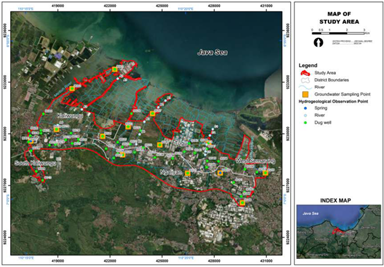
Figure: Map of the study area covering the Tugu, Ngaliyan, and West Semarang Districts, as well as Kaliwungu. read more
“Time Capsule” in Antarctic Rocks Challenges the Old Theory of Gondwana Supercontinent Formation

Publication Monday, 30 March 2026

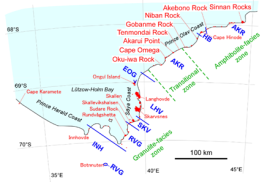
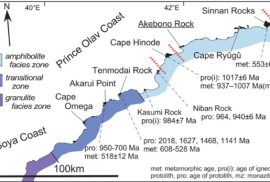
For years, most geological studies have indicated that the Lützow-Holm Complex in East Antarctica experienced regional metamorphism between approximately 600 and 520 million years ago. However, recent research shows that some rocks along the Prince Olav Coast may have undergone metamorphism much earlier than previously estimated.

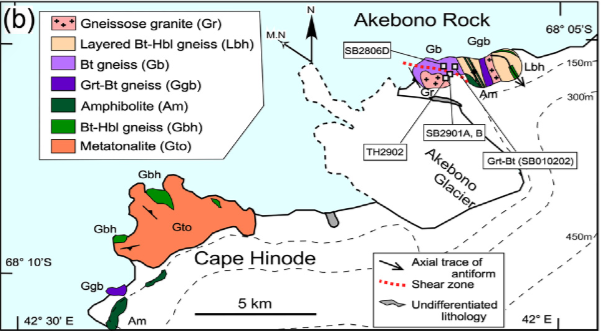
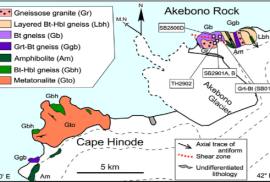
Gambar: Peta  geologi wilayah Cape Hinode dan Akebono Rock

This study focuses on a gneiss rock sample from Akebono Rock, a rock formation on the Prince Olav Coast, East Antarctica. Analysis of the sample indicates prograde metamorphism (an increase in temperature and pressure) that occurred during the Tonian Era with an average age of approximately 937 ± 6 million years. This age is significantly older than the widely accepted estimate for the Lützow-Holm Complex’s regional metamorphism. read more

Antarctic Zircon Crystals Hold Records of Tectonic Plate Collisions Hundreds of Millions of Years Ago

Publication Monday, 30 March 2026

For decades, geologists have been trying to piece together the giant puzzle of how the ancient Gondwana supercontinent assembled. Now, a surprising new piece of the answer has been found inside microscopic crystals buried in the rocks of the Prince Olav Coast, East Antarctica.

An international team of researchers has unraveled the history of high-grade metamorphic rocks in the Lützow-Holm Complex (LHC), discovering that the region’s crustal formation processes are much older and longer than previously estimated. read more

New Geological Discovery in East Antarctica: Tenmondai Rock Reveals a “Counter-Clockwise” Crustal History

Publication Monday, 30 March 2026

An international team of researchers has uncovered a surprising geological evolutionary history in the Lützow-Holm Complex (LHC), East Antarctica. For the first time, scientists have found evidence of a “counter-clockwise” pressure-temperature (P-T) evolution path in the region’s rocks. This discovery challenges the long-held geological consensus that the basement rocks in the Lützow-Holm Complex generally followed only a “clockwise” metamorphic evolution path.

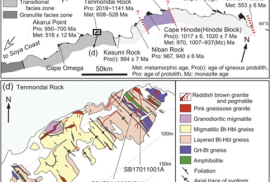
The Lützow-Holm Complex is an Ediacaran to Cambrian-aged orogenic (mountain-building) belt formed by the collision of East and West Gondwana. During the 58th Japanese Antarctic Research Expedition (2016-2017), the research team found anomalies in kyanite-bearing pelitic gneiss rocks collected from the Tenmondai Rock exposure. read more

Curved Crystals in East Antarctica Reveal the Secrets of Ancient Crustal Movement

Publication Monday, 30 March 2026

Deep in the ice lands of East Antarctica, specifically in the Akebono Rock formation, a rare geological phenomenon has been uncovered, providing new insights into the history of ancient crustal movements. At this shear zone location, amphibolite rocks containing large garnet crystals with an internally curved structure resembling the letter “S” (sigmoidal) were discovered. The discovery of these curved-pattern crystals is the first detailed report of rotated phenocrysts in the entire Lützow-Holm Complex (LHC) of Antarctica. This unique pattern in the garnet acts as a natural recorder of past conditions; the crystal’s core records an “S”-shaped growth trail, while its outer rim records a “Z”-shaped trail. This double curved shape indicates that the rock did not merely grow, but also rotated simultaneously due to the incredibly strong friction and pressure of tectonic plates during its formation. read more

Recent Posts

  • Seawater Intrusion Threat in West Semarang Coast, Researchers Emphasize the Importance of Groundwater Conservation
  • “Time Capsule” in Antarctic Rocks Challenges the Old Theory of Gondwana Supercontinent Formation
  • Antarctic Zircon Crystals Hold Records of Tectonic Plate Collisions Hundreds of Millions of Years Ago
  • New Geological Discovery in East Antarctica: Tenmondai Rock Reveals a “Counter-Clockwise” Crustal History
  • UGM Alumnus Ezra Timothy Nugroho Explores Antarctica with International Research Team in the 2026 COOKIES Expedition

Recent Comments

No comments to show.
Universitas Gadjah Mada

Tropical-Polar Interconnection Research Group

© Tropical-Polar Interconnection Research Group UGM

KEBIJAKAN PRIVASI/PRIVACY POLICY