
For years, most geological studies have indicated that the Lützow-Holm Complex in East Antarctica experienced regional metamorphism between approximately 600 and 520 million years ago. However, recent research shows that some rocks along the Prince Olav Coast may have undergone metamorphism much earlier than previously estimated.
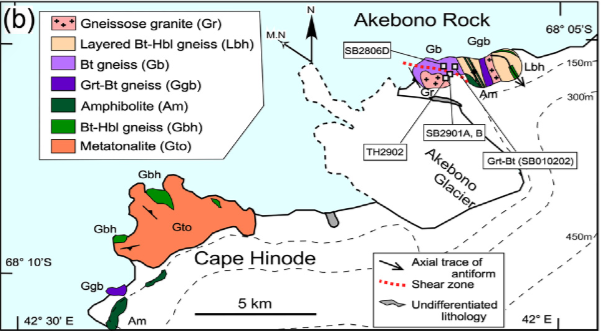
Gambar: Peta geologi wilayah Cape Hinode dan Akebono Rock
This study focuses on a gneiss rock sample from Akebono Rock, a rock formation on the Prince Olav Coast, East Antarctica. Analysis of the sample indicates prograde metamorphism (an increase in temperature and pressure) that occurred during the Tonian Era with an average age of approximately 937 ± 6 million years. This age is significantly older than the widely accepted estimate for the Lützow-Holm Complex’s regional metamorphism.
To determine the rock’s age, researchers used a Sensitive High-Resolution Ion Microprobe (SHRIMP) instrument to analyze zircon minerals found within the rock. Zircon is known as a mineral capable of recording past geological conditions through its crystal growth layers. Uranium-lead (U-Pb) dating on the rim of the zircon crystals revealed an age range of about 972 to 904 million years, with an average of around 937 million years. Thermometric analysis also showed that this metamorphism occurred at a peak temperature of approximately 642°C. This ancient age was then confirmed through the dating of monazite minerals from surrounding rocks, which yielded an age range of about 977 to 917 million years.
The existence of these Tonian-aged rocks raises questions about how this metamorphic record could survive without being completely erased by the regional metamorphic events that occurred hundreds of millions of years later during the Cambrian period. The researchers propose that Akebono Rock is likely an exotic terrane, which is a crustal fragment originating from a different tectonic environment that later accreted to another region. In this scenario, the rock is thought to have originated from an ancient oceanic island arc in the Mozambique Ocean region before finally being trapped within the Cambrian orogenic belt. The presence of linear magnetic anomalies around the area also supports the possibility of a geological discontinuity separating this rock unit from its surrounding areas.
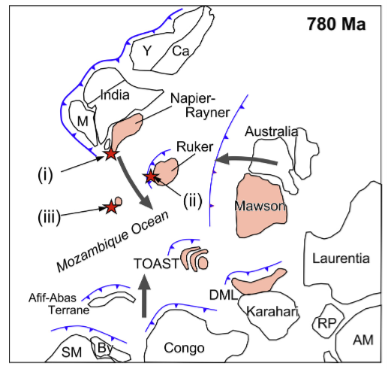
Gambar: Rekonstruksi benua yang disederhanakan memperlihatkan fragmen-fragmen lempeng purba yang tersebar sebelum penyatuan akhir benua super
More than just revising the rock’s age, this discovery has a major impact on how we view Earth’s history globally. These findings align closely with recent paleotectonic reconstructions that challenge old theories regarding the formation of Gondwana. The Gondwana supercontinent, it turns out, was not created by a single, giant, dramatic collision between West and East Gondwana. Instead, the continent was formed through a prolonged amalgamation process involving various micro-continental plates or small-scale terranes.
ARTICLE SOURCE:
- Title: Newly found Tonian metamorphism in Akebono Rock, eastern Dronning Maud Land, East Antarctica.
- Journal: Gondwana Research, Volume 105, 2022 (Halaman 243–261).
- Authors: Sotaro Baba, Kenji Horie, Tomokazu Hokada, Mami Takehara, Atsushi Kamei, Ippei Kitano, Yoichi Motoyoshi, Prayath Nantasin, Nugroho I. Setiawan, and Davaa-ochir Dashbaatar.
- Afiliation: University of the Ryukyus (Jepang), National Institute of Polar Research (Jepang), SOKENDAI (Jepang), Shimane University (Jepang), Kyushu University (Jepang), Kasetsart University (Thailand), Universitas Gadjah Mada (Indonesia), and Mongolian University of Science and Technology (Mongolia).
- DOI: https://doi.org/10.1016/j.gr.2021.09.009