
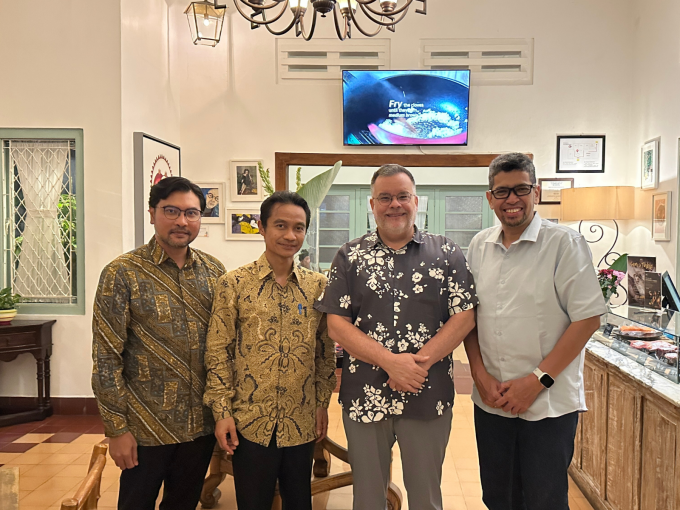
Universitas Gadjah Mada (UGM), together with H.E. Mario Ignacio Artaza, Ambassador of Chile to Indonesia, ASEAN, and Timor-Leste, explored opportunities to strengthen academic and research collaboration, particularly in Tropical–Polar Research and Antarctic-related initiatives.
On Thursday, 18 June 2026, UGM and the Embassy of Chile held a dinner discussion aimed at advancing bilateral cooperation between Indonesia and Chile. The meeting was led by Dr. Danang Sri Hadmoko, Vice Rector for Research, Business Development, and Cooperation at UGM, accompanied by Prof. Dr. Mirwan Ushada, Director of Research at UGM, and Ir. Nugroho Imam Setiawan, S.T., M.T., D.Sc., IPM, Director of the Tropical–Polar Interconnection Research Group. Both parties reaffirmed their commitment to strengthening research collaboration and expanding academic networks to address global challenges through science and innovation.
During the discussion, Ambassador Mario Artaza conveyed his commitment to facilitating communication between UGM and several strategic institutions in Chile that have strong potential for collaboration in Tropical–Polar Research, including the Chilean Antarctic Institute (INACH), Universidad de Magallanes (UMAG), Instituto Milenio BASE, and Universidad de Chile. This facilitation is expected to strengthen institutional linkages, enhance academic exchange, and support the development of joint research initiatives between Indonesia and Chile.
The discussion further highlighted opportunities for broader multidisciplinary collaboration beyond Antarctic and climate-related research. Identified areas of potential cooperation include agriculture and food security, natural resource management, environmental sustainability, marine and fisheries studies, disaster risk management, particularly in architectural building prevention for the earthquake damage, and climate change research.
Particular emphasis was placed on volcanology and geological disaster mitigation, considering that Indonesia and Chile share similar geological characteristics as countries located along the Pacific Ring of Fire. This shared context provides significant potential for collaborative research in volcanic processes, geothermal systems, monitoring technologies, and the environmental and socio-economic impacts of volcanism.
The meeting also underscored the importance of Indonesia’s engagement in Antarctic-related governance and scientific cooperation within the framework of the Antarctic Treaty System (ATS). Antarctica is recognized not only as a region for scientific exploration but also as a strategic area requiring sustained international collaboration to promote peace, environmental protection, and the advancement of global scientific knowledge.
Looking forward, this collaboration is expected to strengthen research partnerships between Indonesia and Chile and contribute to the development of broader international scientific networks. It is further anticipated that such initiatives will support the achievement of the Sustainable Development Goals (SDGs), particularly in relation to climate action, environmental sustainability, and global research collaboration in addressing climate change challenges.
Editor: Anugrah Jorgi Firmansyah
Documentation: Bureau of Strategic Management UGM