
For decades, geologists have been trying to piece together the giant puzzle of how the ancient Gondwana supercontinent assembled. Now, a surprising new piece of the answer has been found inside microscopic crystals buried in the rocks of the Prince Olav Coast, East Antarctica.
An international team of researchers has unraveled the history of high-grade metamorphic rocks in the Lützow-Holm Complex (LHC), discovering that the region’s crustal formation processes are much older and longer than previously estimated.
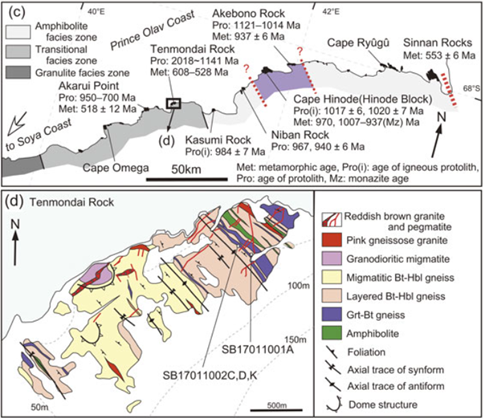
Figure: A map showing the distribution of rock outcrops in the Lützow-Holm Complex, East Antarctica, where researchers collected rock samples from eight different locations
KEY HIGHLIGHTS OF THE DISCOVERY:
- Newly Discovered Ancient Metamorphic Footprints: Researchers detected the oldest metamorphic event that occurred around 990 million years ago in the Niban Rock area, as well as another thermal (heating) event at 931.7 million years ago at Akebono Rock.
- Three Successive Heating Phases: Zircon crystals recorded three main metamorphic stages during the Ediacaran to Cambrian eras: an early stage spanning >600–580 million years ago, a peak condition phase at 580–550 million years ago, and a cooling or retrograde phase at 550–500 million years ago.
- Reshaping the View of Gondwana Assembly: These findings indicate that the early assembly of the central part of the Gondwana supercontinent had already begun with continental plate collisions prior to 580 million years ago as part of the East Africa-Antarctic Orogeny
To “read” the Earth’s past history, the research team utilized an advanced instrument called Laser Ablation Inductively Coupled Plasma Mass Spectrometry (LA-ICP-MS) to conduct U-Pb dating on zircon minerals. Zircon crystals are known for their high durability, capable of locking in the timelines of repeated extreme temperature events without being destroyed.
The team collected samples from eight rock outcrops (Sinnan Rocks, Akebono Rock, Niban Rock, Gobanme Rock, Tenmondai Rock, Akarui Point, Cape Omega, and Oku-iwa Rock) along the Prince Olav Coast. The results showed that these microscopic zircon crystals display multi-layered growth textures (having core, mantle, and rim domains) that record a highly complex multi-thermal history.
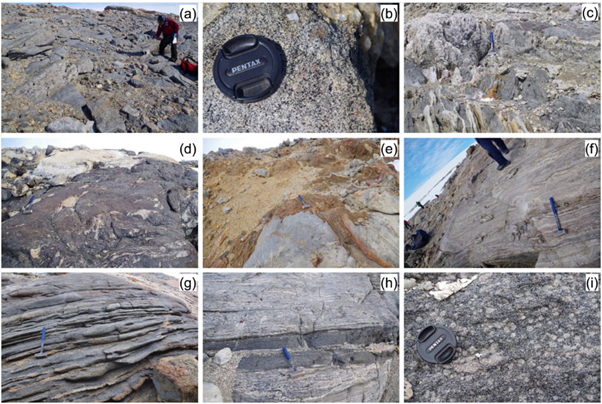
Figure: Rock outcrops in the field
According to the researchers, these multi-layered heating phases prove that the region underwent a continuous continental assembly process. After the initial collision that occurred prior to 580 million years ago, these ancient tectonic plates continued to experience successive collisions driven by the Kuunga Orogeny until around 500 million years ago.
This extensive research project was led by scientists from Kyushu University, in collaboration with various universities and research centers from Japan, Thailand, Indonesia (Universitas Gadjah Mada), and Mongolia. This discovery marks an important leap forward for the geological community in reconstructing the history of supercontinents in the past.
ARTICLE SOURCE
- Title: Zircon geochronology of high–grade metamorphic rocks from outcrops along the Prince Olav Coast, East Antarctica: Implications for multi–thermal events and regional correlations.
- Journal: Journal of Mineralogical and Petrological Sciences, Volume 118, 2023.
- Authors: Ippei Kitano, Tomokazu Hokada, Sotaro Baba, Atsushi Kamei, Yoichi Motoyoshi, Prayath Nantasin, Nugroho I. Setiawan, Davaa–ochir Dashbaatar, Tsuyoshi Toyoshima, Masahiro Ishikawa, Takuma Katori, Nobuhiko Nakano, and Yasuhito Osanai.
- Afiliation: : Kyushu University (Jepang), The Hokkaido University Museum (Jepang), National Institute of Polar Research (Jepang), SOKENDAI (Jepang), University of the Ryukyus (Jepang), Shimane University (Jepang), Kasetsart University (Thailand), Universitas Gadjah Mada (Indonesia), Mongolian University of Science and Technology (Mongolia), Niigata University (Jepang), Yokohama National University (Jepang), and Fossa Magna Museum (Jepang).
- DOI: https://doi.org/10.2465/jmps.221220.