
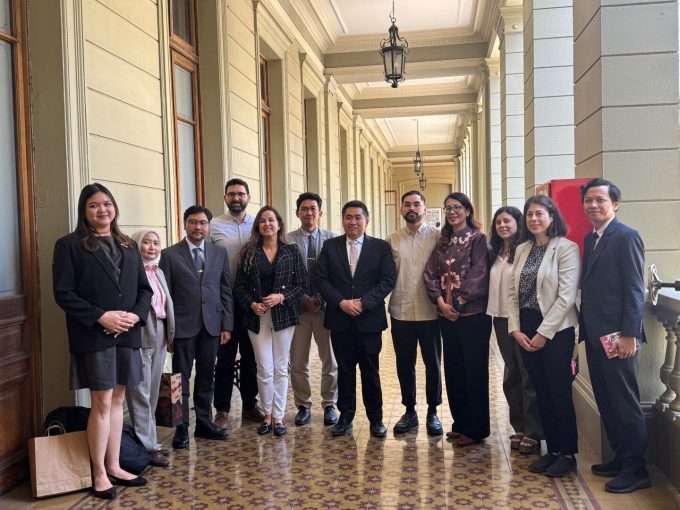
An Indonesian delegation comprising the Ministry of Foreign Affairs, the National Research and Innovation Agency (BRIN), and Universitas Gadjah Mada (UGM) conducted a Strategic Study Visit to Argentina and Chile from November 1 to 11, 2025. The visit is part of ongoing efforts to strengthen Indonesia’s planned involvement in Antarctic governance, while also exploring opportunities to enhance national capacity through scientific diplomacy and polar research cooperation.
The Antarctic region, widely regarded as a barometer of global climate change, is considered to hold significant importance for Indonesia as the world’s largest tropical archipelagic nation and one that is particularly vulnerable to the impacts of climate change. Indonesia also recognizes that its capacity and experience in managing tropical environments can serve as a meaningful contribution to efforts aimed at the preservation and conservation of the Antarctic region.
In Buenos Aires, the Indonesian delegation held meetings with the Secretariat of the Antarctic Treaty System (ATS), the United Nations Democracy Fund (UNDEF), the Argentine Ministry of Foreign Affairs, the Argentine National Research Council (CONICET), and the Argentine Antarctic Institute (IAA). Meanwhile, in Santiago and Punta Arenas, the delegation met with the Chilean Ministry of Foreign Affairs through its Antarctic Division, the Chilean Antarctic Institute (INACH), Universidad de Chile, Pontificia Universidad Católica de Chile (PUC), and Universidad de Magallanes (UMAG).
As one of the Consultative Parties to the Antarctic Treaty System (ATS), Chile has a national Antarctic policy grounded in a multidisciplinary scientific approach. During the series of meetings, both parties discussed best practices in Antarctic governance and opportunities for research collaboration, including UGM’s plans to establish a Polar Research Center and develop a young scientist exchange program.
One of the concrete outcomes of the visit was the signing of a Letter of Intent (LoI) between UGM and Universidad de Chile as an initial step toward establishing academic and institutional cooperation. This agreement is expected to open the door to joint research collaboration, the strengthening of academic networks, and the development of human resource capacity in the field of polar studies.
This visit marks an important milestone in expanding Indonesia’s role in the polar region, while also reaffirming Indonesia’s commitment to contributing to scientific research, global climate change issues, and multilateral cooperation within the framework of the Antarctic Treaty System.