
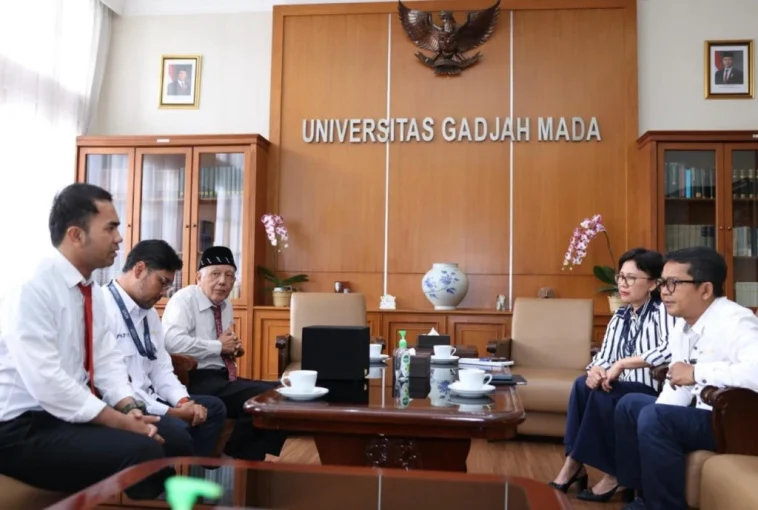
Universitas Gadjah Mada (UGM) has reaffirmed its role in advancing Indonesia’s presence on the international stage through the achievements of two of its alumni, Gerry Utama and Dr. Nugroho Imam Setiawan, both of whom have been involved in research expeditions to Antarctica. UGM Rector Prof. dr. Ova Emilia, M.Med.Ed., Sp.OG(K), Ph.D., expressed her appreciation upon receiving both alumni in an audience on Monday (3/2). She regarded their achievements as not only a source of pride, but also as an inspiration for Indonesian scientists.
According to Ova, the accomplishments of Gerry and Nugroho demonstrate that Indonesian human resources, particularly those from UGM, are capable of competing with researchers from developed nations. UGM has also committed to supporting the advancement of further research and policy related to Antarctica. She opened the possibility of establishing a dedicated Antarctic laboratory or center of study, given the significant potential for contribution in this field. “As long as it can have a positive impact on the nation and the world, UGM is ready to provide its support,” she said.
Regarding the Antarctic Treaty System, which has been ratified by 58 countries, Ova noted that further coordination with the Indonesian government is still needed. The treaty is an important instrument for countries wishing to be actively involved in broad Antarctic exploration. Although Indonesia has not yet indicated readiness to sign the agreement, Ova affirmed that UGM is prepared to guide the process. “We need to have a direct discussion with the government, presenting the positive aspects, what UGM has already accomplished, and what needs to be prepared going forward,” she explained.
Ova further stated that UGM’s commitment to the Antarctic Treaty is part of the university’s contribution to global research with implications for environmental sustainability and climate change. By supporting the participation of Indonesian students and researchers in international scientific expeditions, UGM is also strengthening Indonesia’s position in the governance of the Antarctic region. “We want to raise awareness of the importance of Antarctica as a region that requires serious attention from the international community,” she said.
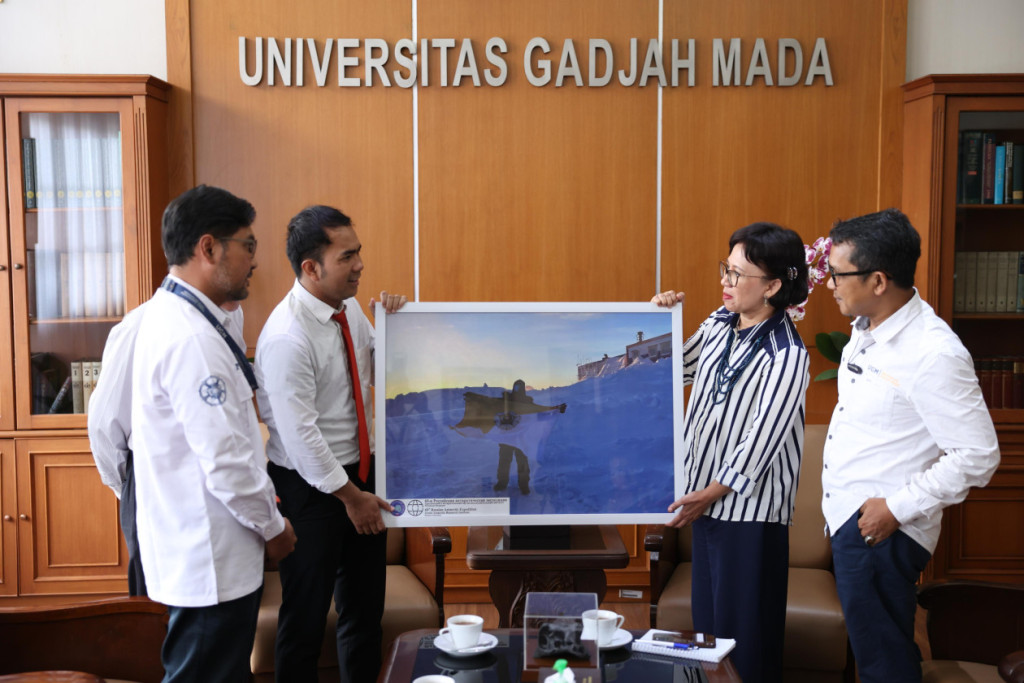
Gerry Utama, an alumnus of the Faculty of Geography, UGM, is recorded as the first Indonesian and the first person from ASEAN to participate in the Russian Antarctic Expedition (RAE), which took place from February to July 2024 while he was pursuing a Master’s degree in Paleogeography at Saint Petersburg State University, Russia. During the expedition, he conducted geomorphological and paleogeographical research to reconstruct a new atlas of King George Island. His research contributed to the understanding of global climate change dynamics, including through the mapping of fossilized wood and moss variations that serve as indicators of past climatic conditions.
At 31 years of age, Gerry is also the youngest researcher in the history of Indonesian missions to Antarctica. He recounted the experience of encountering an enormous iceberg just days after the vessel’s departure. The phenomenon indicated an acceleration of ice melting that could potentially disrupt marine ecosystems and increase risks for coastal areas. He believes Indonesia needs to be more vigilant about this issue, given the country’s nature as an archipelagic nation.
Meanwhile, Dr. Nugroho Imam Setiawan (43), a lecturer at the Department of Geological Engineering, Faculty of Engineering, UGM, previously participated in the Japan Antarctic Research Expedition (JARE) in 2016 to 2017. During that expedition, he studied the evolution of the Antarctic continent through petrological analysis of rocks ranging in age from 2.5 billion to 500 million years old. From that mission, Nugroho successfully published seven international journal articles, contributing to the advancement of global geological science. He also brought back rock samples with honeycomb structures found in Antarctica, which have since been donated to the UGM Biology Museum and the Geological Museum in Bandung.
As the first Indonesian geologist to conduct research on the Antarctic continent, Nugroho explained that the region is still considered terra incognita, a territory that has not yet been extensively revealed through scientific inquiry. As such, every piece of research conducted there carries significant importance, particularly in the field of Earth sciences. In line with Gerry, he hopes the Indonesian government will give greater attention to the natural phenomena occurring in Antarctica. “It must be remembered that Indonesia and Antarctica are not actually separate; we are part of the same Earth system. It is therefore important for Indonesia to be involved in strategic issues such as geopolitics and climate change in order to prepare for possibilities in the future,” he affirmed.
Author: Triya Andriyani
Source: https://ugm.ac.id/id/berita/ugm-siap-dorong-partisipasi-indonesia-pada-traktat-antartika/